

Table of Contents
- Why Fresh Roasted Coffee Tastes Different
- The Bloom: Carbon Dioxide Leaving the Bean
- The Coffee Bloom Test: A 30-Second Freshness Check
- Coffee Roast Date Importance: Read the Bag Before You Buy
- Visual, Aroma, and Taste Clues That Separate Fresh From Stale
- How to Store Coffee Beans for Freshness
- How Roast Level and Grind Size Change the Freshness Clock
- Frequently Asked Questions
Last Updated: September 11, 2026
Why Fresh Roasted Coffee Tastes Different
Fresh roasted coffee tastes different because it is still releasing carbon dioxide, a natural byproduct of roasting that carries aroma compounds out of the bean and into your cup. Once that gas dissipates, oxygen moves in and the flavor flattens. This guide from Battle Ready Coffee breaks down how to tell if coffee is fresh roasted using the bloom, the roast date, and a few sensory checks you can run in under a minute.
The chemistry is simple enough. Green coffee holds hundreds of volatile compounds locked inside a dense cellular structure. Roasting fractures that structure and drives off moisture, and the bean spends the next several days venting gas. During that window, the coffee is at its most expressive. After it, the bean is a shell holding onto whatever oxygen got in first.
That is the entire freshness story. Everything below is a way of measuring where a bag sits on that timeline.
The Bloom: Carbon Dioxide Leaving the Bean
The bloom happens when hot water hits coffee grounds and the trapped carbon dioxide escapes in a rush of bubbles and foam. That foam is not cosmetic. It is the bean proving it still has gas to release, which is the clearest single signal that the coffee was roasted recently.
Degassing starts the moment roasting ends. A bean might shed a large share of its carbon dioxide within the first few days and continue releasing the rest over the following weeks. The exact pace depends on roast level, bean density, and how the coffee was stored. Darker roasts degas faster because roasting has already opened the bean's structure further.
Here is what matters for your kitchen: a vigorous bloom means the coffee still has something to give. A weak or absent bloom means most of the gas is already gone, and with it a good portion of the aroma you paid for.
The Coffee Bloom Test: A 30-Second Freshness Check
The coffee bloom test is a quick way to judge freshness by pouring hot water over a small sample of grounds and watching how much the bed expands. A fresh roast blooms into a thick, domed layer of foam. A stale roast barely reacts.
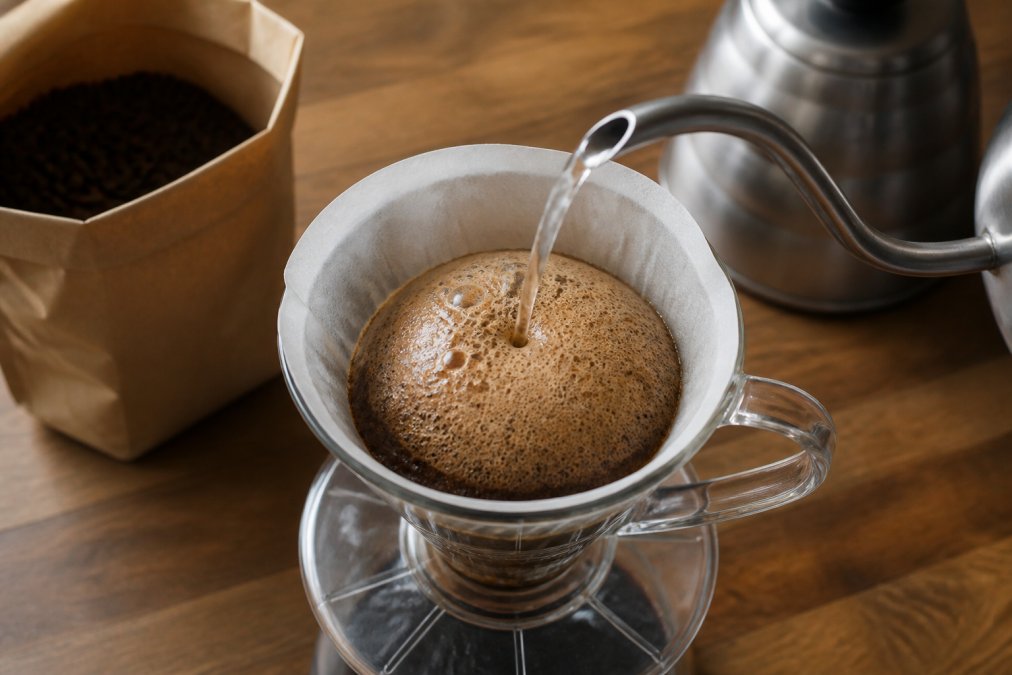
How to Run the Test Step by Step
- Heat water to just off boiling. For most roasts, water between 195°F and 205°F works well. Let a kettle rest for 30 seconds after it boils.
- Measure two tablespoons of grounds into a glass or mug. Use the same grind you normally brew with so the comparison stays fair.
- Pour a small amount of water over the grounds and stop. You want just enough to saturate the bed, roughly double the volume of the coffee.
- Watch for 30 seconds. Note how high the foam rises and how long it holds.
- Smell the foam. Fresh coffee releases a sweet, bready, sometimes fruity aroma at this stage.
- Compare against a known-fresh batch. Run the same test with coffee you trust as a baseline.
What you are looking for: a bloom that rises quickly, holds for several seconds, and smells like the tasting notes on the bag. A bed that barely puffs, or one that collapses within a second or two, points to coffee that has already spent its best days.
One caveat. Water quality affects how the bloom behaves. Very soft or heavily filtered water can mute the reaction, while mineral-rich water tends to produce a fuller bloom. If your tap water tastes flat, the test result may understate the coffee's actual freshness.
Coffee Roast Date Importance: Read the Bag Before You Buy
Coffee roast date importance comes down to this: the roast date tells you exactly how old the coffee is, while a "best by" date tells you almost nothing. Always look for the roast date first. If a bag only shows an expiration date months in the future, treat it as a warning sign rather than a guarantee.
Roasters who care about freshness print the day the beans left the drum. A roast date within the last two to three weeks is a strong indicator for filter brewing. Espresso drinkers often prefer a slightly longer rest, since very fresh beans can be hard to dial in. Beyond roughly six weeks, most coffee has lost the volatile compounds that made it interesting.
A "best by" date is usually calculated as a fixed window from roasting, often several months out, and it says nothing about when the coffee was actually roasted. Some bags carry a batch date instead, which serves the same purpose as a roast date. Either one is useful. A lone expiration date is not.
Whole bean versus pre-ground matters here too. Ground coffee exposes far more surface area to oxygen, so it stales dramatically faster than whole bean. If you buy pre-ground, buy it in small amounts and use it quickly. The Specialty Coffee Association's guidance on coffee freshness covers how storage and surface area interact over time.
Visual, Aroma, and Taste Clues That Separate Fresh From Stale
Fresh coffee looks matte and slightly uneven in color, smells sweet and complex, and tastes bright with clear acidity. Stale coffee looks glossy, smells papery or hollow, and tastes flat. Your senses catch what the packaging will not tell you.
Start with the beans themselves. Fresh whole beans have a dry, matte surface. As coffee ages and oils migrate to the surface, the beans take on a sheen. A light oiliness on a dark roast is normal right after roasting, but heavy gloss on a medium roast usually means the coffee has been sitting a while. The FDA's guidance on food storage and shelf life is a useful reference for how oxygen exposure degrades stored food products generally, and coffee follows the same basic pattern.
Aroma is the next check. Open the bag and smell it. Fresh coffee hits you with something specific: chocolate, citrus, berry, nuts, whatever the roast is supposed to be. Stale coffee smells like cardboard, sawdust, or nothing much at all. That flat, papery note is oxidation at work.
Then there is taste.
What Stale Coffee Smells and Tastes Like
Stale coffee smells papery, hollow, and faintly like dry cardboard. It tastes flat and muted, with the bright acidity replaced by a dull, sometimes rancid or woody finish. If you have to add milk and sugar to make a cup drinkable, the coffee is probably the problem, not your brewing.
A useful comparison is cupping, the professional sensory evaluation method roasters use to score coffee. Cupping isolates flavor and aroma without brewing variables getting in the way. You do not need a formal setup, but the principle holds: taste the coffee black, at a consistent strength, and judge the flavor profile on its own terms. Fresh coffee has a clear beginning, middle, and end. Stale coffee is one flat note.
How to Store Coffee Beans for Freshness
Storing coffee beans for freshness comes down to blocking three things: oxygen, moisture, and light. An airtight container kept in a cool, dark cupboard will outperform almost any other home storage method.
Oxygen exposure is the main driver of staling. Every time you open a bag and let air in, oxidation accelerates. A sealed, opaque container limits that exposure to the moments you actually scoop beans out. Glass jars look nice on the counter, but clear glass lets light in, which degrades oils over time. If you like the look, keep the jar in a cabinet.
Moisture matters too. Coffee is hygroscopic, meaning it absorbs water from the air. A humid kitchen, a spot above the stove, or a container that does not seal properly will all shorten shelf life. Keep beans dry and away from steam.
Freezing is worth a mention because the advice is so often garbled. Freezing whole beans in an airtight container works well for long-term storage, provided you let the container come to room temperature before opening it. The problem is repeated freeze-thaw cycles, which introduce condensation every time. Portion the beans out first, then freeze what you will not use within a couple of weeks.
What about the refrigerator? Skip it. Fridges are humid, and coffee picks up odors from everything else in there.
Packaging Technology: One-Way Valves and Airtight Containers
A one-way valve is a small membrane built into a coffee bag that lets carbon dioxide escape while keeping oxygen out. It exists because a fully sealed bag of fresh coffee would inflate and eventually burst as the beans degas. The valve solves that problem without exposing the coffee to outside air.
This is where packaging technology separates good roasters from careless ones. A bag with a one-way valve and a roast date is doing real work to protect the coffee. A bag with neither is relying on you to drink it fast. Once you open any bag, the valve stops mattering much, which is why transferring beans to an airtight container after opening is the better long-term move.
At Battle Ready Coffee, every order is roasted only after it is placed, so the beans arrive close to their peak rather than weeks past it. That shortens the window you have to worry about in the first place.
How Roast Level and Grind Size Change the Freshness Clock
Roast level and grind size both change how fast coffee goes stale. Darker roasts and finer grinds age faster because both increase the coffee's exposure to oxygen.
Dark roasts spend longer in the roaster, which breaks down more of the bean's cellular structure and drives off more of its internal gas. That leaves the bean more porous and more vulnerable to oxidation. A dark roast might taste noticeably flatter after three weeks, while a light roast of the same batch could still be drinking well. Roast level variations are one reason two bags with identical roast dates can age at completely different rates.
Grind size works on the same principle. Pre-ground coffee has vastly more surface area than whole bean, so it stales in a fraction of the time. If you buy pre-ground, buy small quantities and use them within a week or two. If you grind at home, grind right before brewing. That single habit does more for cup quality than almost any piece of equipment you can buy.
A note on water: the water you brew with shapes what you taste as much as the coffee does. Heavily chlorinated or overly soft water can mute the acidity and sweetness that fresh coffee is supposed to deliver. If your coffee tastes dull despite a recent roast date, try filtered water before you blame the beans.
If you want a roast that holds up well and arrives fresh, the Whiskey Barrel Aged is a single-origin Guatemalan aged 30 days in a bourbon barrel and roasted to order, priced at $23.99. It is a good example of a bean where the roast date and the aging process both matter to what ends up in the cup.

Judging coffee freshness is a skill you build in a few weeks of paying attention, and the payoff is a consistently better cup. Battle Ready Coffee roasts every order only after it is placed, so the beans you get are already near peak rather than weeks past it, and the roast date on the bag tells you exactly where you stand. With 100% Combat Veteran ownership, ethically sourced beans, and free delivery anywhere in the US, there is no guesswork about what you are getting. Find your roast and start brewing coffee that still has something to say.
Frequently Asked Questions
How long after roasting should you wait to brew coffee?
Most beans hit their best flavor 4 to 14 days after the roast date. During the first few days, heavy degassing can make espresso pull thin and sour, so many drinkers rest beans for 3 to 5 days before brewing. Pour-over and drip tolerate younger beans better. If your bag has no roast date, treat the batch date as a rough stand-in and expect faster staling.
Is coffee roasted 4 months ago still good?
It is safe to drink, but it will not taste fresh. Once oxidation sets in, the bright acidity and layered tasting notes fade, leaving flat, papery, or cardboard-like flavors. Whole bean coffee holds up longer than pre-ground because less surface area is exposed to oxygen. For peak flavor, aim to finish a bag within 2 to 4 weeks of the roast date.
What are the physical signs of stale coffee beans?
Look for a dull, matte surface instead of the glossy sheen fresh beans carry from surface oils. Stale beans feel lighter and more hollow, and they barely bloom when hot water hits them. The aroma turns weak or papery rather than sweet and roasty. If your beans show several of these signs at once, the batch is past its prime.
Does the roast date on a coffee bag really matter?
Yes. Coffee roast date importance comes down to oxidation: the clock starts the moment beans leave the roaster, not when you open the bag. A roast date tells you exactly how much time has passed, while a vague expiration date can sit 12 months out. Bags with a printed roast date, a one-way valve, and whole beans give you the best odds of a fresh cup.