

Table of Contents
- Why Ethical Coffee Sourcing Claims Are Hard to Verify
- Fair Trade Coffee Certification Requirements: What the Label Actually Means
- How to Read a Coffee Bag Label for Sourcing Clues
- Coffee Supply Chain Transparency: How to Do Your Own Due Diligence
- Spotting Greenwashing in Coffee Marketing
- Is Expensive Coffee Worth the Price? What You're Actually Paying For
- The Economic Impact of Middle-Men in the Coffee Supply Chain
- Frequently Asked Questions
Last Updated: September 10, 2026
Why Ethical Coffee Sourcing Claims Are Hard to Verify
Learning how to verify ethical coffee sourcing starts with an uncomfortable truth: most bags give you almost nothing to verify. "Ethical" has no legal definition in the United States, so any roaster can print it. This guide walks through the certifications, labels, and questions that separate a real commitment from marketing copy.
Ethical coffee sourcing is the practice of buying coffee in a way that ensures farmers receive fair compensation, labor rights are respected, and environmental harm is minimized throughout the supply chain.
The verification problem is structural. Coffee passes through growers, cooperatives, exporters, importers, and roasters, and each handoff is a place where documentation can thin out. A roaster who buys through a broker may genuinely not know the farm-gate price, so their "ethical" claim rests on trust rather than evidence.
Most guides hand you a list of certification logos and stop there. Logos tell you a standard was met at some point, not what the farmer was paid, whether the audit was recent, or whether the roaster has any relationship with the producer. Below, we'll show you how to check each of those things yourself, in about ten minutes per bag.
Fair Trade Coffee Certification Requirements: What the Label Actually Means
Fair Trade coffee certification requires producers to meet social, economic, and environmental standards, verified by an independent auditor, in exchange for a guaranteed minimum price and a community development premium. The certification is administered in the United States by Fair Trade USA, which sets the standards and licenses the label.
The requirements fall into three buckets:
- Economic standards: a minimum price floor paid to the cooperative, plus an additional premium the cooperative votes on how to spend
- Labor standards: no forced or child labor, safe working conditions, and freedom of association
- Environmental standards: restricted agrochemicals, water protection, and waste management
What the label does not require is a direct roaster-farm relationship. A roaster can buy certified green coffee on the open market, never speak to a producer, and still print the mark, legitimate, but different from a roaster who knows the cooperative by name.
Fair Trade vs. Direct Trade: The Key Differences
Fair Trade is a third-party certification with published standards and independent audits. Direct Trade is not a certification at all, it's a sourcing claim that a roaster buys directly from producers, usually above commodity prices and often on longer-term contracts.
That distinction matters because Direct Trade has no governing body, so any roaster can claim it. Direct relationships often produce better coffee and more money reaching the farm, but you're relying entirely on the roaster's transparency. One doing it well publishes farm names, regions, and often the price paid; one using it as marketing publishes nothing.
The Role of Third-Party Verification and Audits
Third-party verification turns a sourcing claim into something you can check. An independent auditor inspects the farm or cooperative against the standard and issues a certificate with an expiry date, the part most buyers overlook.
Certifications are audited on cycles, typically annually, and a lapsed certificate means the standard is no longer being checked. For coffee specifically, look for USDA Organic certification if organic practices matter to you, and note that organic and ethical are separate claims. A coffee can be certified organic and still be sourced without any labor or pricing standard.
| Certification | What It Verifies | What It Doesn't Verify |
|---|---|---|
| Fair Trade | Price floor, premium, labor and environmental standards | Direct roaster-farm relationship |
| USDA Organic | Growing practices, restricted inputs | Farmer pay or labor conditions |
| Bird Friendly | Shade-grown habitat standards | Economic terms for farmers |
| Direct Trade | Nothing, unless the roaster publishes evidence | Anything, by default |
How to Read a Coffee Bag Label for Sourcing Clues
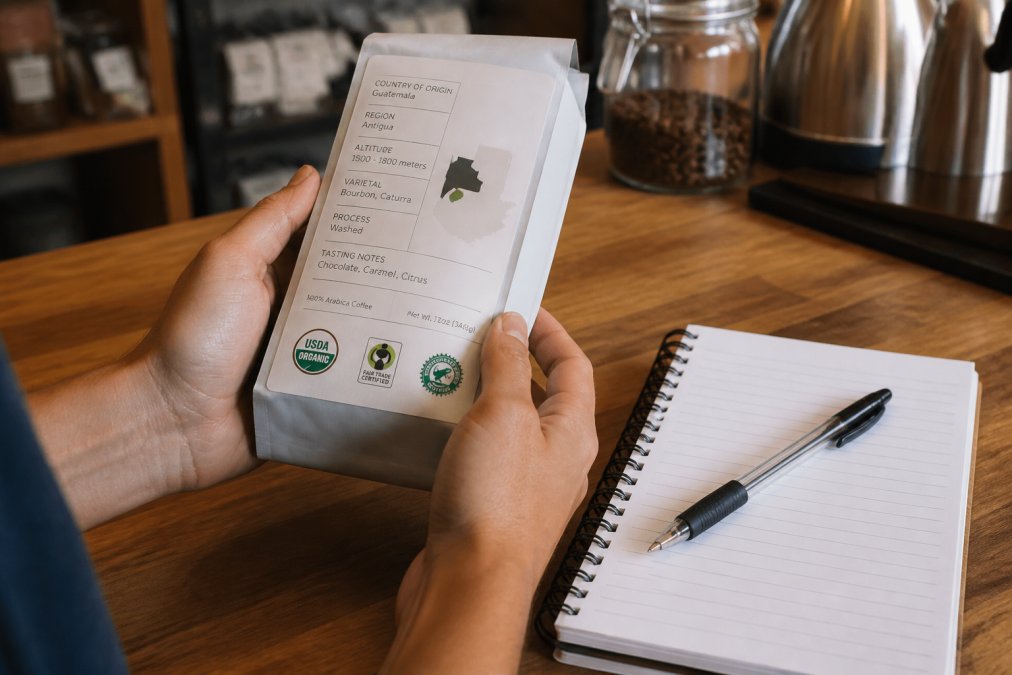
The front of the bag is marketing; the back and bottom are where the facts live. A label supporting an ethical claim carries the origin down to the region or cooperative, the altitude, the processing method, and a roast date. One that doesn't carries a country name and a lot of adjectives.
Work through these in order:
- Find the origin. "Colombia" is a country. "Medellin, Antioquia" is a region. "Smallholder farmers from Medellin" is a supply chain. The more specific the origin, the more traceable the coffee.
- Check the altitude. Altitude is a quality marker, and publishing it signals the roaster knows the lot. A bag listing 1,300 to 1,500 meters is telling you something concrete.
- Read the processing method. Fully washed, natural, or honey processing changes flavor and tells you how the producer handled the crop.
- Look for the variety. Named cultivars like Bourbon, Typica, or SL28 indicate a roaster working closely enough with the supply chain to know what they bought.
- Find the roast date. This is the freshness clock, not the sourcing clock.
Roast Date vs. Sourcing Date: Why the Distinction Matters
A roast date tells you when the coffee was roasted. A sourcing date would tell you when it was purchased or harvested, and almost no roaster prints one, the gap that confuses buyers most.

Coffee is a seasonal crop, and green coffee holds quality for months when stored properly, so a bag roasted last week can contain coffee harvested over a year ago. That's not automatically bad, but "freshly roasted" and "freshly sourced" are different claims, and only one is usually on the label.
For freshness specifically, roast date is the number that matters, and it should be a printed date, not a "best by" estimate. Battle Ready Coffee roasts only after an order is placed.
Coffee Supply Chain Transparency: How to Do Your Own Due Diligence
Coffee supply chain transparency means a roaster can show you where the coffee came from and how it was bought. You can test that in ten minutes with nothing more than their website.
Run this check:
- Search the site for the farm or cooperative name on the bag
- Look for a sourcing or impact page with named origins, not just certification logos
- Check whether they publish the region and altitude for each lot
- See if they name the importer or exporter they work with
- Look for a contact route to ask a direct question
The last item is the real test. A roaster with a genuine supply chain will answer a question about a specific lot. One using "ethical" as decoration will send a generic reply about their commitment to farmers.
Digital Verification Tools and What They Reveal
Digital verification is the fastest way to check a claim without emailing anyone. Certification bodies now offer online registries where you can look up a licensed business and confirm the certificate is current.
Some importers also publish lot-level documentation tracing a shipment from cooperative to roaster. When a roaster links to it, you can verify origin without taking their word for it; when they don't, the absence is itself information.
Spotting Greenwashing in Coffee Marketing
Greenwashing in coffee usually shows up as vague language doing the work of a specific claim. The Federal Trade Commission publishes Green Guides guidance on environmental marketing claims, and the principle behind it applies here: a claim should be specific, substantiated, and not overstated.
These phrases are warning signs when they appear alone:
- "Ethically sourced" with no certification, farm name, or price detail
- "Sustainable" with no environmental standard named
- "Farmer friendly" or "community focused" with no named program
- Certification logos with no license number or registry entry
- Stock photography of farmers instead of the actual producing partners
None of these phrases is illegal, they're just unverifiable, which is the opposite of what you want. The tell is always specificity: a roaster who pays above-market prices will tell you, one who visits farms will show you, and one who does neither will write about values.
Is Expensive Coffee Worth the Price? What You're Actually Paying For
Higher specialty coffee prices generally reflect four things: green coffee cost, roast and packaging quality, the freshness model, and the length of the chain between farm and roaster. Knowing which you're paying for tells you whether a bag is worth it.
Commodity coffee trades on a global exchange, and the farm-gate price can sit below what it costs a smallholder to produce the crop. Specialty coffee commands more at origin for quality, altitude, variety, and processing, and part of that premium can reach the producer, but only if the roaster's buying model is built to send it there.
Where the money goes instead is the middle of the chain. Every layer between farm and roaster takes a margin, and layers adding no quality or traceability are pure cost, the case for buying from roasters who shorten the chain and can name who they bought from.
For a concrete comparison, Battle Ready Coffee's single-origin lots sit at $23.99 per bag, and each one names the grower, region, altitude, variety, and processing method. The Specialty Coffee Association's research on the coffee value chain outlines how quality-based pricing is meant to work through the chain. That level of disclosure is the practical difference between paying for coffee and paying for a story.
- Bali Blue ($23.99): smallholder farms in Kintamani, Bali, at 1,200 to 1,600 meters, with dark chocolate and molasses notes
- Colombia ($23.99): smallholder farmers from Medellin, Antioquia, at 1,300 to 1,500 meters, fully washed and solar dried
- Ethiopia Natural ($23.99): smallholder farmers in the Sidama zone at 1,700 to 1,900 meters, dried on raised beds
- Kenya ($23.99): Othaya, Nyeri County, at 1,700 to 1,890 meters, with SL28 and SL34 varieties
The Economic Impact of Middle-Men in the Coffee Supply Chain
Intermediaries aren't automatically a problem. Exporters handle logistics, financing, and quality control most smallholder cooperatives can't do alone, and that work has real value. The issue is intermediaries who add cost without adding traceability.

When coffee changes hands multiple times before reaching a roaster, the producer's share of the retail price shrinks with each margin, and the paper trail gets harder to follow. A roaster buying through several layers often can't tell you the farm-gate price because they genuinely don't know it.
Shortening the chain changes both: fewer handoffs mean more of the retail price reaches origin, and each remaining step is easier to document. Cooperative structures matter too, a well-run cooperative aggregates smallholder harvests, negotiates for members, and provides traceability individual farmers can't.
The practical takeaway is simple: ask who the roaster bought from. A named cooperative or importer with a lot number means the chain is short enough to verify; a distributor means you've found the layer costing the farmer.
Verifying an ethical sourcing claim takes about ten minutes and a willingness to ask one direct question. Battle Ready Coffee publishes the grower, region, altitude, variety, and processing method on every single-origin lot, roasts only after your order is placed, and delivers free anywhere in the country. The beans come from smallholder farms, the roastery is 100% combat veteran owned. Find your roast.
Frequently Asked Questions
What are the most reliable third-party certifications for ethical coffee?
The most widely recognized certifications include Fair Trade USA, USDA Organic, Rainforest Alliance, and Bird Friendly. Each verifies different standards: Fair Trade focuses on fair pricing and labor rights, USDA Organic covers environmental practices, Rainforest Alliance addresses sustainability and biodiversity, and Bird Friendly requires shade-grown production. Look for specific certification logos on packaging, not vague claims like 'sustainably sourced.' Cross-reference the certifying body's website to confirm the roaster's status. Multiple certifications together provide stronger assurance than any single label.
How can I tell if a coffee brand is actually paying farmers a fair wage?
Start by checking for Fair Trade certification, which sets minimum farmer-paid prices and requires a social premium. For Direct Trade claims, look for published farm-gate prices or farmer partnerships on the roaster's website. Transparency matters: brands that disclose cooperative names, regions, and pricing demonstrate accountability. If a roaster cannot or will not share where beans come from and how much farmers receive, that is a red flag. Battle Ready Coffee, for example, lists specific regions and grower cooperatives for each single-origin offering.
What is the difference between Fair Trade and Direct Trade coffee?
Fair Trade certification uses third-party auditors to set minimum prices and labor standards, providing a structured safety net for smallholder farmers. Direct Trade skips the certification body; roasters negotiate directly with farmers, often paying above Fair Trade minimums but without standardized verification. Direct Trade can offer higher prices and closer relationships, but it depends entirely on the roaster's integrity. Fair Trade offers verifiable benchmarks. The strongest approach combines both: direct relationships backed by third-party verification and transparent pricing.
Does a 'sustainably sourced' label guarantee ethical treatment of workers?
No. 'Sustainably sourced' is not a regulated term in the United States and can refer to environmental practices alone, ignoring labor rights entirely. A coffee could be grown with minimal environmental impact while workers are underpaid or exposed to unsafe conditions. To verify ethical treatment, look for certifications that explicitly address labor rights, such as Fair Trade USA or Rainforest Alliance, and check whether the roaster publishes supply chain audits or cooperative partnerships. Demand specifics: named farms, regions, and verifiable standards.