

Table of Contents
- Why High Caffeine Coffee Works Before a Morning Workout
- Caffeine Timing for Athletic Performance: When to Drink Your Coffee
- How Much Caffeine Is Safe Before Exercise?
- Coffee vs Synthetic Pre-Workout Supplements
- How to Avoid the Caffeine Crash After Your Morning Workout
- Choosing the Best High Caffeine Coffee for Your Routine
- Conclusion
- Frequently Asked Questions
Last Updated: September 12, 2026
Why High Caffeine Coffee Works Before a Morning Workout
Caffeine is the most widely used performance-enhancing substance in the world, and for good reason: it works. At Battle Ready Coffee, customers who train before sunrise often ask whether their morning cup is doing anything for their workout.
It is. Caffeine blocks adenosine receptors in the brain, reducing fatigue perception and boosting central nervous system stimulation, translating to better focus, higher stamina, and a measurable endurance bump.
Research summarized by the International Society of Sports Nutrition position stand on caffeine supports caffeine as an effective ergogenic aid for aerobic performance, muscular endurance, and anaerobic power. It also increases fat oxidation and supports glycogen sparing, meaning your body leans on stored fat for fuel and preserves muscle glycogen for later in the session.
The catch: dose, timing, and the coffee itself all matter. Get one wrong and you either feel nothing or feel terrible.
Caffeine Timing for Athletic Performance: When to Drink Your Coffee
Drink your coffee 45 to 60 minutes before training. That window puts peak plasma concentration roughly at the start of your session, when you need it most.
Caffeine's half-life sits around five hours in most adults, so an early cup clears well before bed. Caffeine timing for athletic performance is not just about the workout; it protects sleep quality, which drives recovery.
The 2-Hour Rule and Peak Plasma Concentration
The "2-hour rule" is a common guideline, but it is often misread: it does not mean drinking coffee two hours before training.
Blood caffeine levels typically peak 30 to 60 minutes after ingestion on an empty stomach. The two-hour figure is the upper end of the near-peak window, useful for longer sessions or delayed starts.
- 45-60 minutes before: standard for most morning workouts
- 90-120 minutes before: useful for long endurance events or when you eat a full meal first
- 30 minutes before: acceptable if you train fasted and want a sharper onset
A common mistake is drinking coffee the moment you wake up and training 10 minutes later. You get the ritual, but you train before the caffeine has done its job.
How Much Caffeine Is Safe Before Exercise?
For most healthy adults, 3 to 6 milligrams of caffeine per kilogram of body weight, taken about an hour before exercise, is the range supported by sports nutrition guidance, roughly 200 to 400 milligrams for a 70-kilogram adult.
How much caffeine is safe before exercise depends on body weight, tolerance, and cardiovascular conditions. Start at the low end: 200 milligrams improves performance for most non-habitual high-dose users.
Dosage Guidelines by Body Weight
| Body Weight | Low Dose (3 mg/kg) | Moderate (4-5 mg/kg) | High (6 mg/kg) |
|---|---|---|---|
| 60 kg (132 lb) | 180 mg | 240-300 mg | 360 mg |
| 70 kg (154 lb) | 210 mg | 280-350 mg | 420 mg |
| 80 kg (176 lb) | 240 mg | 320-400 mg | 480 mg |
| 90 kg (198 lb) | 270 mg | 360-450 mg | 540 mg |
Two things to watch: habitual use builds tolerance, so the same dose delivers less over time, and genetics affect metabolism, some people clear caffeine twice as fast as others.
The FDA's guidance on caffeine and health notes that 400 milligrams per day is generally not associated with negative effects in healthy adults, but that individual sensitivity varies widely.
Coffee vs Synthetic Pre-Workout Supplements
Coffee and synthetic pre-workout supplements both deliver caffeine, but they are not interchangeable. The difference is everything else in the cup or scoop, and for a morning workout, that matters.
What Is Actually in Each Option
A typical synthetic pre-workout lists caffeine anhydrous as the primary stimulant, often 200 to 350 milligrams per scoop, plus beta-alanine, citrulline, taurine, tyrosine, betaine, and B-vitamins. Many also contain artificial sweeteners and colors, and 'proprietary blends' that hide individual doses behind a single number.
Coffee contains caffeine plus chlorogenic acids, trigonelline, magnesium, potassium, and polyphenols. Those compounds are not just along for the ride: chlorogenic acids are associated with the slower, smoother absorption curve many coffee drinkers notice versus a fast-acting anhydrous capsule.
Where Coffee Wins for a Morning Workout
- Hydration synergy: coffee is roughly 98 percent water, and the diuretic effect of a single cup is smaller than most people assume. A synthetic pre-workout is mixed in 8 to 12 ounces of water but often contains added sodium and stimulants that increase fluid loss.
- Smoother curve: the natural compounds in coffee blunt the spike-and-crash pattern that fast-absorbing caffeine anhydrous can produce.
- Fewer additives: no proprietary blends, no mystery doses, no artificial colors or sweeteners.
- Cost per serving: a home-brewed cup runs a fraction of the per-scoop cost of most tubs, even before you factor in the higher-end formulas.
- Ritual and routine: the act of brewing and drinking coffee is itself a pre-workout cue for many athletes, which supports consistency.
Where Synthetic Pre-Workouts Win
Precision. A measured scoop delivers exactly 300 milligrams with no variability, while coffee varies by bean, roast, grind, and brew method. Synthetic formulas also let you stack ergogenic ingredients, beta-alanine for buffering, citrulline for blood flow, at doses impractical from food alone.
That precision comes with trade-offs: proprietary blends hide what you are getting, artificial sweeteners and colors concern some users, and the fast absorption curve can produce a sharper crash than coffee.
A Practical Decision Framework
For most morning trainees, coffee is the better default: cheaper, better tasting, and the performance difference at matched caffeine doses is small. The natural matrix also sits better on an empty stomach than a concentrated powder.
Save the synthetic tub for competition days or sessions needing a precise, repeatable dose. If you use one, look for a formula that lists every ingredient with its dose, avoids proprietary blends, and keeps caffeine under 300 milligrams per scoop so you can stack it with your morning coffee without overshooting.
The Bottom Line
Coffee and synthetic pre-workouts are tools for different jobs. Coffee is the everyday driver: hydrating, additive-free, and smooth enough for a fasted morning session. Synthetic pre-workouts are the precision instrument, best reserved for days when exact dosing matters more than ingredient quality. For a morning workout, the everyday driver usually wins.
How to Avoid the Caffeine Crash After Your Morning Workout
The crash is not caused by caffeine itself but by the rebound: adenosine blocked during your workout floods back once caffeine clears, and blood sugar swings from a fasted session amplify the dip. The fix is a protocol, not a single habit.
Why the Crash Happens
Caffeine works by blocking adenosine receptors in the brain. Adenosine builds up while you are awake and creates sleep pressure; when caffeine occupies the receptors, adenosine cannot bind, so you feel alert. But adenosine keeps accumulating in the background the entire time.
When caffeine clears, typically three to five hours after your cup, all that accumulated adenosine binds at once, causing a sudden drop in alertness that feels disproportionate to the dose. Add a fasted workout, which depletes glycogen and raises cortisol, and the dip gets sharper.
The Three-Part Crash Protocol
1. Eat protein and fiber within an hour of finishing. A fasted workout plus caffeine on an empty stomach is the fastest route to a mid-morning slump. Aim for 20 to 30 grams of protein and at least 5 grams of fiber, eggs, Greek yogurt with berries, or oatmeal with nuts all change the curve. Protein slows gastric emptying and stabilizes blood sugar; fiber extends satiety. If you cannot eat a full meal, a protein shake with fruit is a reasonable bridge.
2. Drink water, not more coffee. Caffeine has a mild diuretic effect, and dehydration mimics fatigue, many people reach for a second cup when they are actually under-hydrated. Target 16 to 20 ounces of water in the hour after your workout, plus electrolytes if you sweated heavily.
3. Taper your dose, do not stack it. A second coffee two hours after the first extends the crash rather than preventing it. If you need sustained energy, split your total dose: most before training, a smaller amount an hour after. If your target is 300 milligrams, take 200 before the workout and 100 about 60 minutes after.
What Not to Do
- Do not chase the crash with sugar. A pastry or energy drink spikes blood sugar, then drops it further, deepening the slump.
- Do not take a second full dose of caffeine. It delays the crash rather than preventing it, and it pushes your afternoon caffeine load into the window that disrupts sleep.
- Do not skip breakfast and rely on caffeine alone. A fasted workout is fine; a fasted post-workout window is where the crash lives.
- Do not ignore sleep debt. If you are chronically short on sleep, no caffeine protocol will fully compensate. The crash is worse when you are already behind.
Timing the Fix
The crash typically hits 3 to 5 hours after your cup. If you drink coffee at 6 a.m., expect the dip around 9 to 11 a.m. Plan protein and water to land before that window, eating at 8 a.m. beats eating at 10 a.m. when you already feel the slump.
Choosing the Best High Caffeine Coffee for Your Routine
The best high caffeine coffee for a morning workout is a dark roast blend with a robusta component, brewed strong, and consumed 45 to 60 minutes before training. Robusta beans carry roughly twice the caffeine of arabica, so a blend that includes them delivers more per cup without forcing you to drink more volume.
Bean choice stops being a taste preference and becomes a performance decision: a light arabica single origin may be delicious, but it will not deliver the same caffeine load as a robusta-forward blend.
Battle Ready Coffee roasts every order only after it is placed. Caffeine content is stable in storage, but the oils and aromatics are not, and freshly roasted beans brew more consistently, so your dose estimate is more reliable week to week.
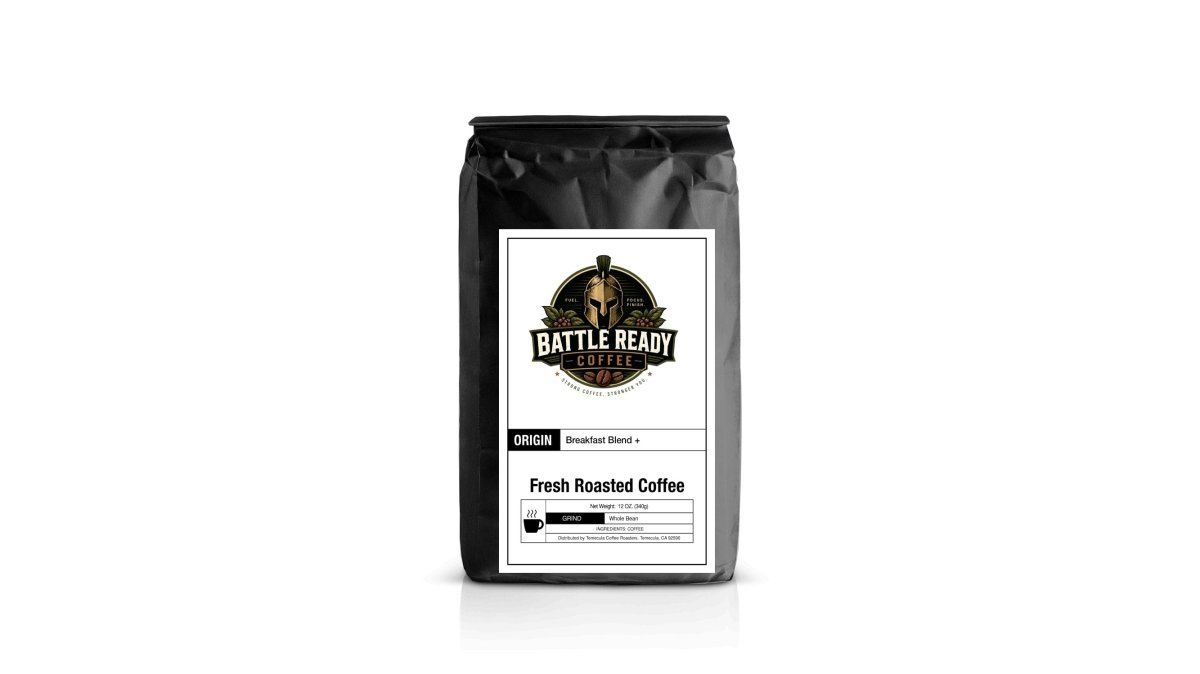
For a morning training routine, the Max Caf Blend is the direct answer: a Tanzania and India robusta blend built specifically for high caffeine output. If you want something smoother with a moderate lift, the Breakfast Blend + adds a shot of robusta to a medium roast for a firmer kick without the aggressive edge. Both are available whole bean or ground, so you can match the grind to your brewer.

Stomach Sensitivity and Hydration Tips
Coffee on an empty stomach before a workout triggers gastrointestinal distress for many people: acidity and caffeine both stimulate gut motility, and training on a churning stomach ruins a session.

Four fixes that work:
- Cold brew instead of hot: lower acidity, easier on the stomach
- Eat a small amount first: half a banana or a slice of toast buffers the acid
- Dilute it: a longer water-to-coffee ratio reduces the concentration hitting your gut
- Skip the second cup: most stomach issues come from total volume, not the first serving
On hydration, drink 12 to 16 ounces of water alongside your coffee and another 8 ounces during warm-up. The diuretic effect of a single cup is modest but stacks with sweat losses. Empty-stomach absorption is fast, which is why the 45-minute window works, but it also means caffeine and acid hit at once. Plan for both.
Conclusion
The gap between a coffee that fuels your workout and one that just wakes you up comes down to three decisions: the bean, the dose, and the timing. Most people get the timing wrong and never adjust the bean.
Battle Ready Coffee roasts to order and ships free anywhere in the US, so the bag that arrives is fresh enough to brew consistently. Start with the Max Caf Blend for a robusta-forward caffeine load, or the Breakfast Blend + if you want a smoother medium roast with extra kick. Every order is roasted after it is placed, backed by a 5.0 customer rating and a 100% combat veteran owned operation.
Find your roast and build a morning routine that actually performs.
Frequently Asked Questions
Should I drink coffee before I work out in the morning?
Yes, for most people it helps. Caffeine is an ergogenic aid that blocks adenosine receptors, which reduces perceived fatigue and raises central nervous system stimulation. A cup of high caffeine coffee 30 to 60 minutes before training can improve endurance capacity, cognitive focus, and stamina. If you train at very high intensity or have blood pressure concerns, start with a smaller dose and see how your body responds.
How long before a workout should I drink high caffeine coffee?
Aim for 30 to 60 minutes before you start. Caffeine reaches peak plasma concentration roughly 45 to 60 minutes after drinking, so a cup right before you walk into the gym means you are still climbing when your first set begins. If you drink it on an empty stomach, absorption is faster. For early sessions, set your coffee up the night before so timing is not a scramble.
Is 200mg of caffeine before the gym bad?
For most healthy adults, 200mg is a moderate dose, roughly two 8-ounce cups of brewed coffee, and sits well inside the range research supports for performance enhancement. The concern is stacking. If you also take a pre-workout supplement, check the label for caffeine anhydrous, since combined doses can push you past 400mg, the level health agencies treat as the upper limit for most adults.
Does high caffeine coffee provide better performance than synthetic pre-workouts?
Coffee brings more than caffeine. It also delivers chlorogenic acids and other compounds linked to fat oxidation and glycogen sparing, and it is a whole food rather than a blend of isolates. Synthetic pre-workouts can dose caffeine more precisely and often add beta-alanine or citrulline. If you want a natural ergogenic aid with fewer additives, coffee is the simpler choice. If you want exact milligram control, a supplement wins on precision.